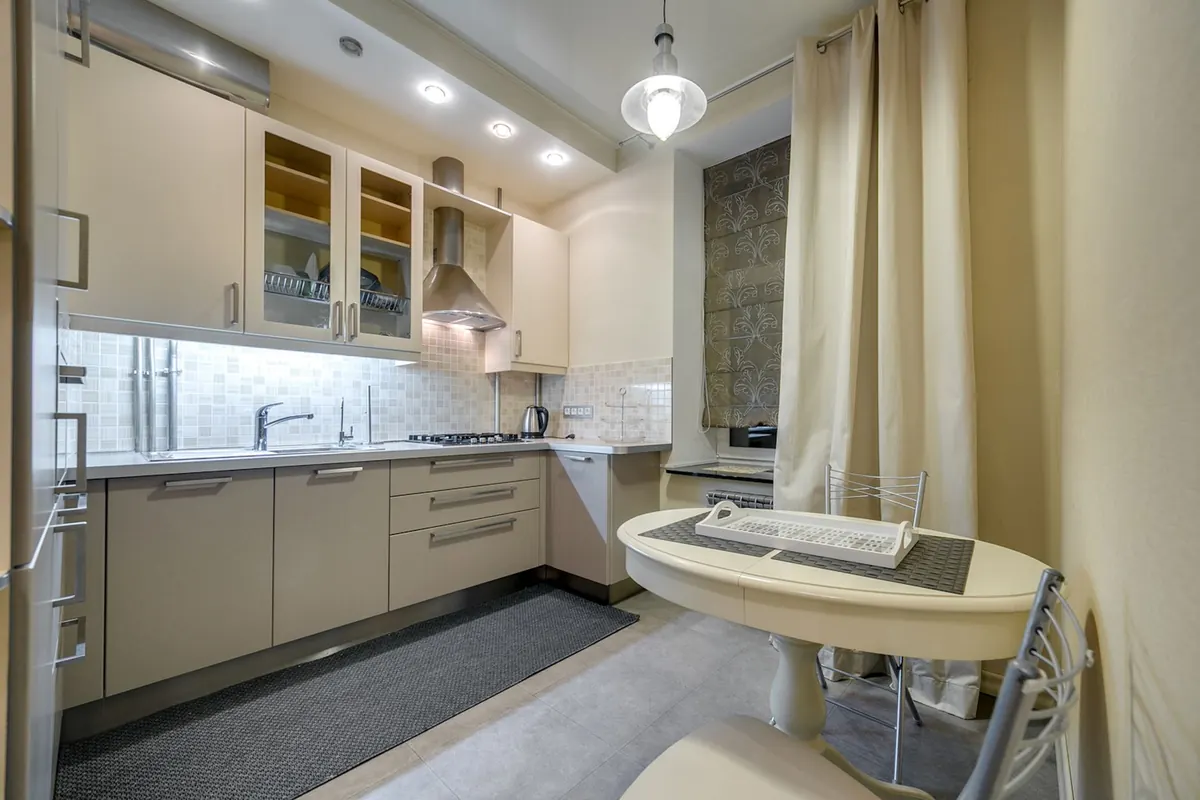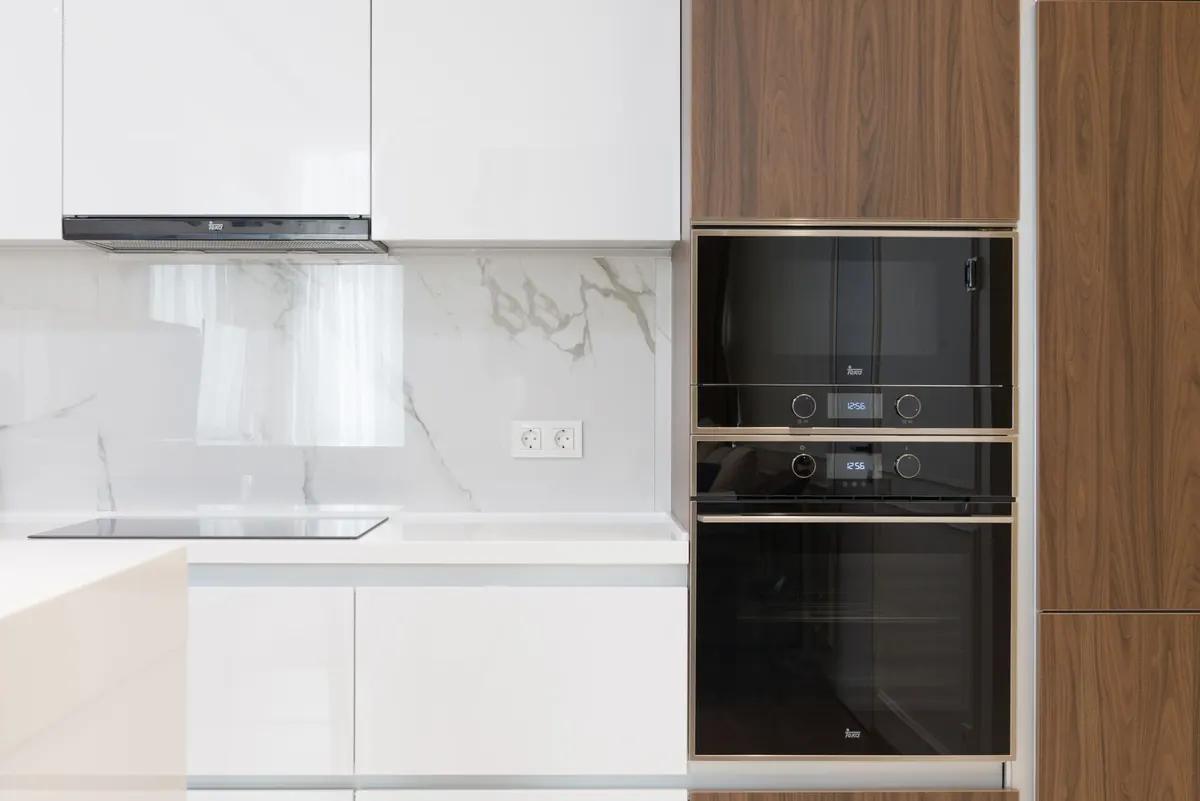
Appliance shopping tends to happen at the end of a kitchen project, once the units are ordered and the budget is already tight. That is a problem, because whether you choose freestanding or integrated appliances affects your cabinets, your worktop, your flooring and how easily a plumber can reach a valve. Freestanding is cheaper, simpler to repair and easy to replace. Integrated looks calmer and lets the cabinetry do the talking. Neither wins outright, so it is worth understanding the trade-offs before you commit.
What "integrated" and "freestanding" actually mean
A freestanding appliance is a complete box. It has its own sides, top, front and controls, it stands on the floor, and it sits in a gap or at the end of a run. Freestanding fridges, dishwashers, washing machines and range cookers all work this way.
Integrated is a looser term covering two different things:
- Built-in: the appliance slides into a housing but keeps its own front panel, handles and controls. Most single ovens and compact microwaves work like this.
- Fully integrated: the appliance hides behind a furniture door that matches your cabinets. Dishwashers, larder fridges and under-counter freezers are the usual examples.
The distinction matters at replacement time. A built-in oven sits in a fairly standard 600mm housing, so swapping brands is usually straightforward. A fully integrated dishwasher depends on a decor door, a hinge system and a mounting kit that are all specific to that model.
The look of the room
Stand at the doorway and compare two 4m runs. In the first, an integrated dishwasher disappears behind the same door style as the cupboards either side, and a tall housing hides the fridge. The eye reads one continuous band of cabinetry. In the second, a stainless dishwasher with its own fascia, handle and control strip interrupts the run, and a freestanding fridge stands beside the units with a visible gap and a different finish.
That interruption is not automatically bad. A range cooker in a pale, plain kitchen is often the best thing in it, and a freestanding fridge suits a farmhouse or industrial scheme where appliances are meant to be seen. The catch is colour drift: appliance finishes move on every few years, while your cabinet doors stay the same. If you pick a bold appliance colour now, you are committing to it. If you hide the appliances, the kitchen ages more gracefully — but you give up the option of changing the look later without new cabinetry.
Where the money actually lands
Freestanding appliances usually cost less than integrated equivalents with similar functions, and you pay nothing extra to house them. The saving is real, but it is only half the picture.
With integrated appliances you are also buying the housing carcass, the furniture doors, the handles and hinges, the plinth venting for a fridge, and the fitter's time per appliance. That can add up to more than the appliance itself. Integrated models also tend to give you slightly less usable space for the same footprint — a cabinet surrounds them, and the plinth and compressor housing take up room a freestanding fridge would use for shelves.
So compare total installed cost, not the price tag on the appliance. If you want to keep costs down without losing the clean look, spend on integrated appliances where they are visible in a run of cabinets — a dishwasher under the worktop, a fridge in a tall housing — and go freestanding for a range cooker that was always going to be a feature anyway.
Repairs and service access
When something breaks, freestanding wins comfortably. A freestanding dishwasher can be pulled out and worked on from every side. An integrated one is bolted to a cabinet door, boxed in by units, and often approached through a recess behind the plinth. Some repairs need the appliance out on the floor first, which takes longer and costs more in labour.
You can make an integrated kitchen far easier to live with:
- Ask the fitter to leave an accessible service void and an isolating valve you can reach without dismantling a plinth.
- Lay the finished floor through the whole room before the appliances go in, or a later repairer may be unable to slide a dishwasher out.
- Keep a copy of the model numbers, the appliance manual and the name of the door manufacturer in the kitchen drawer. Future you will not remember the finish name.
- Check the manufacturer's installation requirements before buying, since some guarantees assume a particular housing or clearance.
Replacement is where integrated kitchens get awkward
Replacing a freestanding appliance is a measuring job: check the width, depth and height, allow a few millimetres each side, and order. Dishwashers are commonly around 600mm wide, with slimline versions around 450mm, so most gaps can be filled.
Integrated is a matching job. A new fully integrated dishwasher has to line up with your existing decor door — panel height, hinge type, and how the door fixes to the appliance front. If the model has been discontinued and the new one uses a different bracket, you may be re-drilling a door or paying for a new one. Fridges are stricter still, because the furniture door and the housing were made for a specific appliance height.
Before you commit, note the door finish, colour name and supplier, and ask for a spare decor door panel if the budget stretches. It is cheap insurance against a discontinued design.
How the choice shapes your layout
Small kitchens and galley runs
Integrated appliances buy you continuous worktop. An under-counter integrated fridge lets you install a counter above it, which a freestanding model cannot offer. In a narrow galley, that extra surface is worth more than the repair convenience you give up.
Clearances and door swings
Freestanding fridges need enough room in front to open past 90 degrees if the drawers are to come out, and range cookers need space beside them for hot oven doors. Integrated appliances use your cabinet door, so the swing is drawn into the design from the start rather than discovered on delivery day.
Services and structure
Plan where the socket, water supply and waste go. With integrated appliances, services are best run behind an adjacent cabinet so they stay reachable. If you are moving a gas connection to a new built-in hob, use a registered engineer; electrical work on new circuits should go to a qualified electrician.
The hybrid option
Most kitchens we see are mixed, and that is usually the sensible answer: integrated dishwasher and fridge for a clean run, freestanding range cooker where the kitchen wants a focal point, and a freestanding washing machine in a utility room where nobody sees it.
Deciding between them
Ask yourself three blunt questions. How long will you stay in this kitchen? How tight is the budget once installation, doors and fitting are included? And what happens on the day an appliance dies — do you want to order a new one online, or call a fitter and hope the door still matches?
If you expect to move within a few years, or you like the flexibility of upgrading appliances without touching the cabinetry, freestanding is the lower-risk choice. If the kitchen is a long-term project and you want the cabinets to read as one piece of furniture, integrated earns its extra cost — as long as you protect yourself with a spare door, accessible services and written-down model details.
Decide this before you order cabinets, not after. Then tell your designer which appliances are freestanding, so the gaps, the clearances and the service void are drawn correctly rather than squeezed in on site.
Photo: Max Vakhtbovych / Pexels